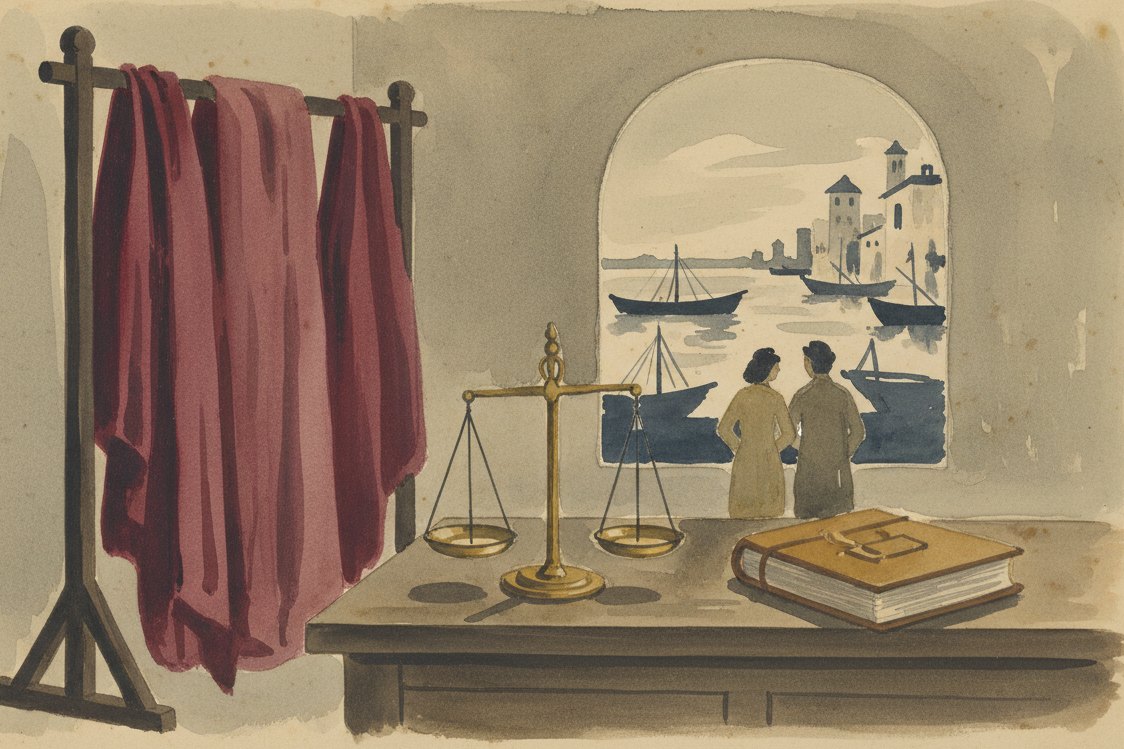
The render is a stylized impression of pile sheen.
- First documented
- Middle Ages
- Fiber
- silk, cotton, polyester
- Weave
- warp pile, cut
- Family
- pile
Plate No. 052 · fabric
Velvet
Velvet is a pile cloth: an extra warp is woven over fine rods or against a second cloth, then cut, so the surface is a dense field of upright silk or cotton tufts with no visible weave at all. The cut pile absorbs and returns light unevenly, which is why velvet appears to change shade as it moves and why no flat cloth ever looks as deep. Medieval Italy, above all Genoa, Florence, and Venice, built fortunes on silk velvet for courts and cardinals, and the cloth has signified luxury ever since. The render is a stylized impression of pile sheen; velvet has no pattern geometry to draw.
Named for
From the Latin villus, a tuft of hair: velvet is a surface made entirely of tufts.
In the record
- 1400sThe velvet workshops of Genoa, Florence, and Venice made Italian silk velvet the standard of European luxury.
Common questions
- What is Velvet made of?
- Velvet is a pile cloth: an extra warp is woven over fine rods or against a second cloth, then cut, so the surface is a dense field of upright silk or cotton tufts with no visible weave at all.
- Where does Velvet come from?
- Velvet comes from Italy, where it dates to the Middle Ages.
- What is Velvet named after?
- From the Latin villus, a tuft of hair: velvet is a surface made entirely of tufts.
Often confused with
Sources & References
Related specimens



Stay in the loop
From the Almanac
Updates from Fabric Almanac, when there is something worth sharing.