A coarse, fulled, slightly ribbed twill woolen.
- First documented
- Middle Ages
- Fiber
- wool
- Weave
- coarse ribbed twill woolen, fulled
- Family
- twills
Plate No. 136 · fabric
Kersey
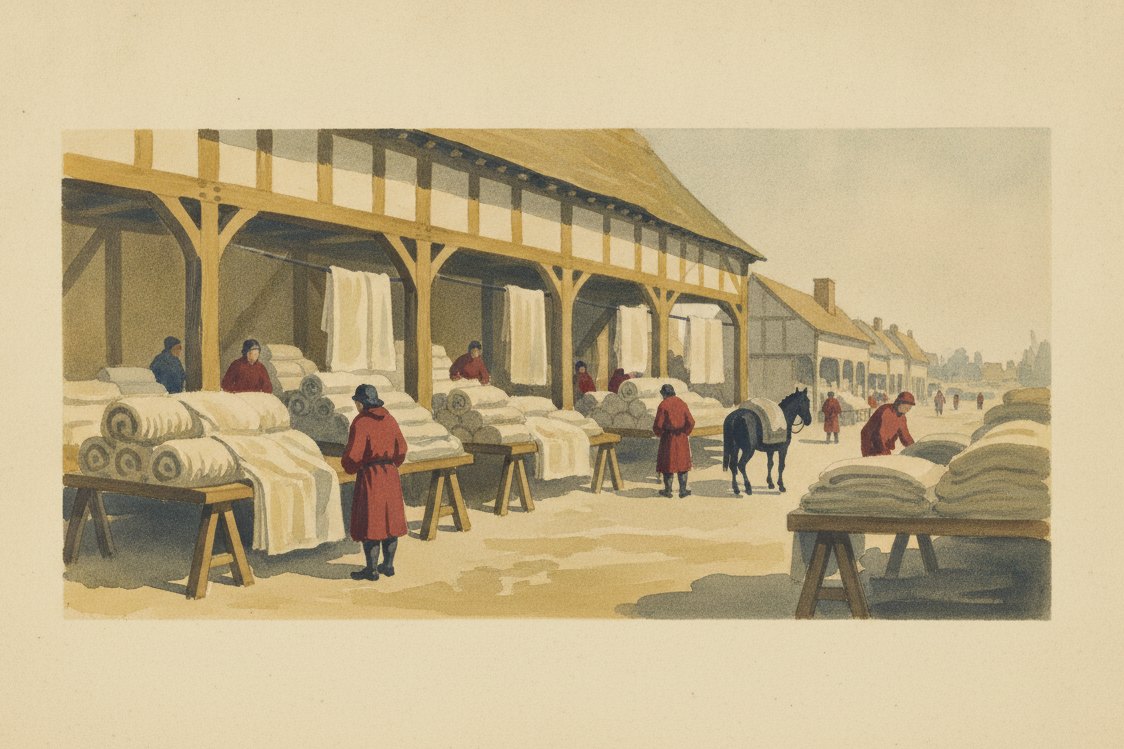
Kersey is a coarse, hard-wearing woolen, woven as a narrow twill and fulled to a dense, slightly ribbed cloth. For centuries it was one of England's great export staples, the workaday partner to the finer broadcloth, made up into hose, breeches, work clothes, and soldiers' coats across medieval and early modern Europe. Cheap, warm, and durable, it clothed ordinary people and armies rather than courts, and its name, like so many English cloths, is simply the village where it was first made.
Named for
Named for the village of Kersey in Suffolk, an early center of its weaving.
Modern equivalent
The closest cloth in this catalogue you can source today.
Common questions
- What is Kersey made of?
- Kersey is a coarse, hard-wearing woolen, woven as a narrow twill and fulled to a dense, slightly ribbed cloth.
- What is Kersey named after?
- Named for the village of Kersey in Suffolk, an early center of its weaving.
Where to buy
- Burnley & Trowbridge Co.
An 18th century reproduction textile and notions shop, stocking wool, linen, and cotton yardage for historical costuming and reenactment, plus in-person and online sewing workshops.
They also run sewing workshops.
Merchants we think are worth buying from. We take nothing for these listings.
Sources & References
- 1.Kersey (cloth), Wikipedia
- 2.Woolen, Wikipedia
Related specimens


Stay in the loop
From the Almanac
Updates from Fabric Almanac, when there is something worth sharing.