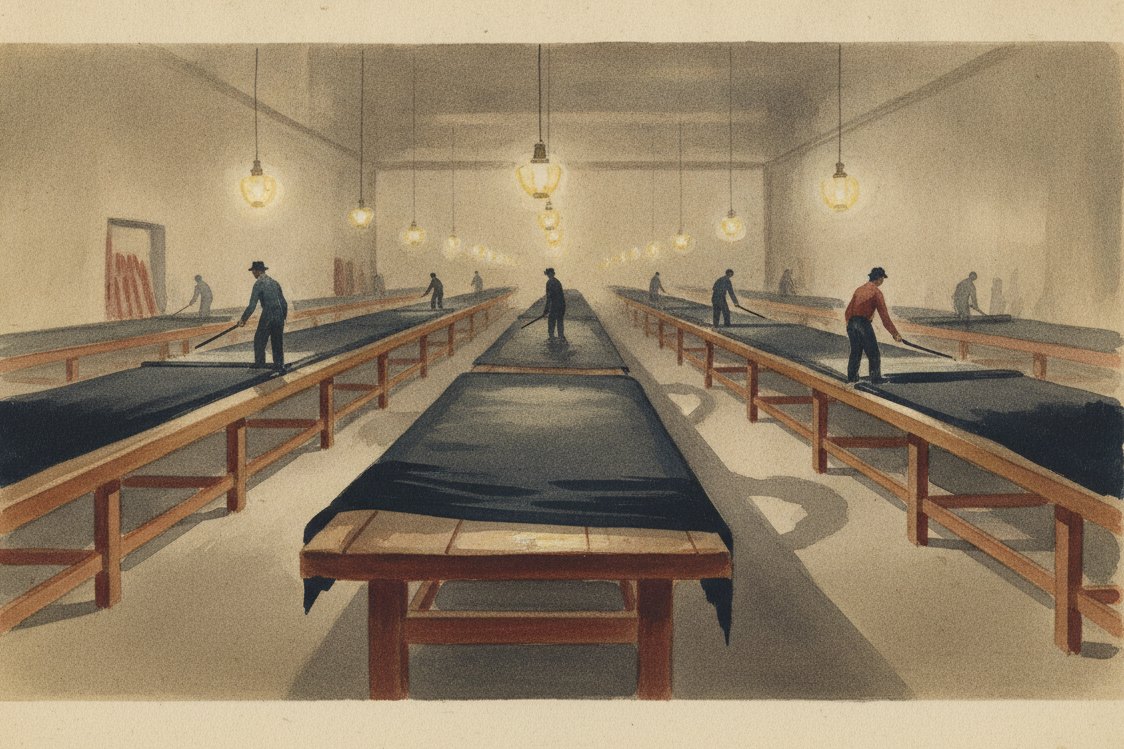
The render is a stylized impression of the sheared cotton face.
- First documented
- Middle Ages
- Origin
- Egypt and the Mediterranean, Egypt
- Fiber
- cotton, linen
- Weave
- stout cotton, often weft pile
- Family
- pile
Plate No. 072 · fabric
Fustian
Fustian is the family name behind half the workwear in this catalogue: stout cotton cloths, often woven with an extra weft that could be left plain or cut into pile. Medieval fustian mixed linen warp with cotton weft; industrial Lancashire made all-cotton fustians the uniform of labor, and the cutters who slit the pile by hand, walking miles per bolt down a cutting table, were a trade of their own. Cut and ribbed, fustian becomes corduroy; cut flat, moleskin; cut soft, velveteen. The family tree of hard-wearing pile starts here.
Named for
Traditionally from Fustat, the old quarter of Cairo where the cloth was traded; the derivation is traditional. The word also came to mean pompous language, cloth and bombast both being thick stuff.
Modern equivalent
The closest cloth in this catalogue you can source today.
Common questions
- What is Fustian made of?
- Fustian is the family name behind half the workwear in this catalogue: stout cotton cloths, often woven with an extra weft that could be left plain or cut into pile.
- Where does Fustian come from?
- Fustian comes from Egypt, where it dates to the Middle Ages.
- What is Fustian named after?
- Traditionally from Fustat, the old quarter of Cairo where the cloth was traded; the derivation is traditional. The word also came to mean pompous language, cloth and bombast both being thick stuff.
From the journal
Sources & References
Related specimens




Stay in the loop
From the Almanac
Updates from Fabric Almanac, when there is something worth sharing.