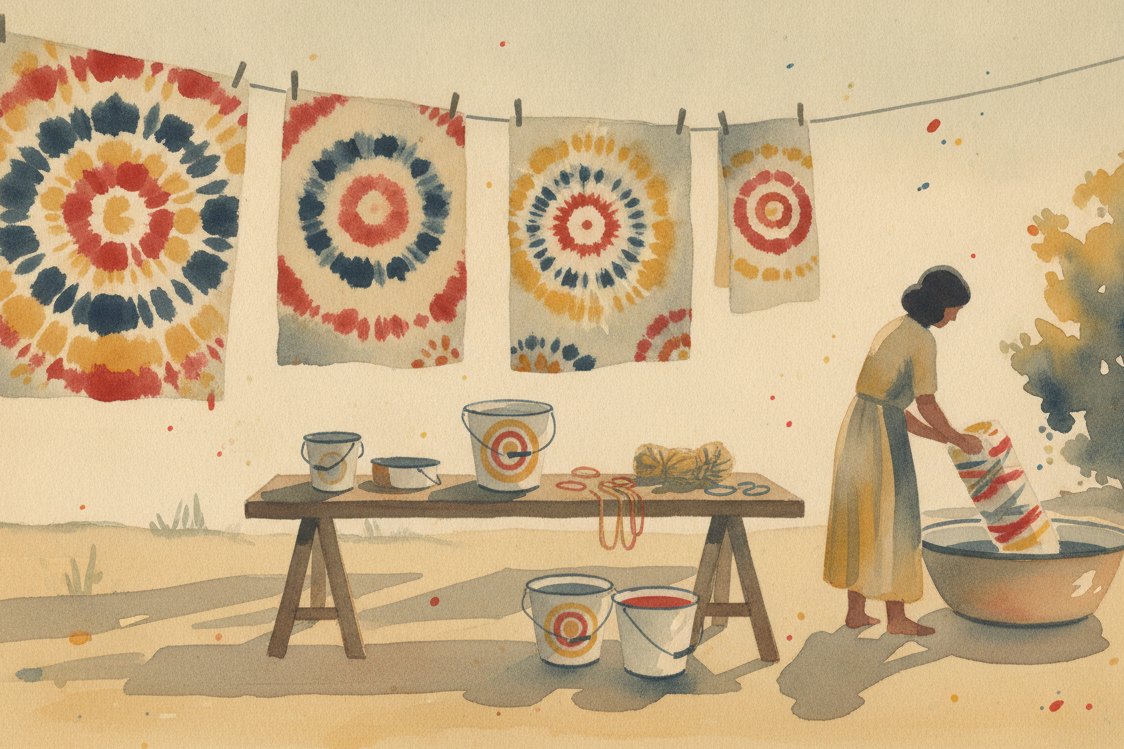
Rings blooming outward from each bound point, a stylized resist burst.
- First documented
- Antiquity
- Origin
- worldwide, United States
- Fiber
- cotton
- Weave
- resist pattern: cloth bound, then dyed
- Family
- prints
Plate No. 154 · pattern
Tie-Dye
Tie-dye is a resist pattern made by binding, folding, knotting, or stitching cloth so that dye cannot reach the bound areas, leaving them pale against the dyed ground. The technique is ancient and grew up independently around the world, in the bandhani of India, the shibori of Japan, the adire of West Africa, and the textiles of pre-Columbian Peru. The swirling, multicolored spiral that the word now calls to mind in the West is a much more recent thing, the badge of 1960s American counterculture, where rediscovered resist dyeing became a homemade emblem of psychedelia.
Named for
Descriptive: the cloth is tied, then dyed, so the bound parts resist the color.
Common questions
- What is Tie-Dye made of?
- Tie-dye is a resist pattern made by binding, folding, knotting, or stitching cloth so that dye cannot reach the bound areas, leaving them pale against the dyed ground. It is traditionally made of cotton.
- Where does Tie-Dye come from?
- Tie-Dye comes from the United States, where it dates to Antiquity.
- What is Tie-Dye named after?
- Descriptive: the cloth is tied, then dyed, so the bound parts resist the color.
Often confused with
From the journal
Sources & References
- 1.Tie-dye, Wikipedia
- 2.Resist dyeing, Wikipedia
Related specimens

Stay in the loop
From the Almanac
Updates from Fabric Almanac, when there is something worth sharing.