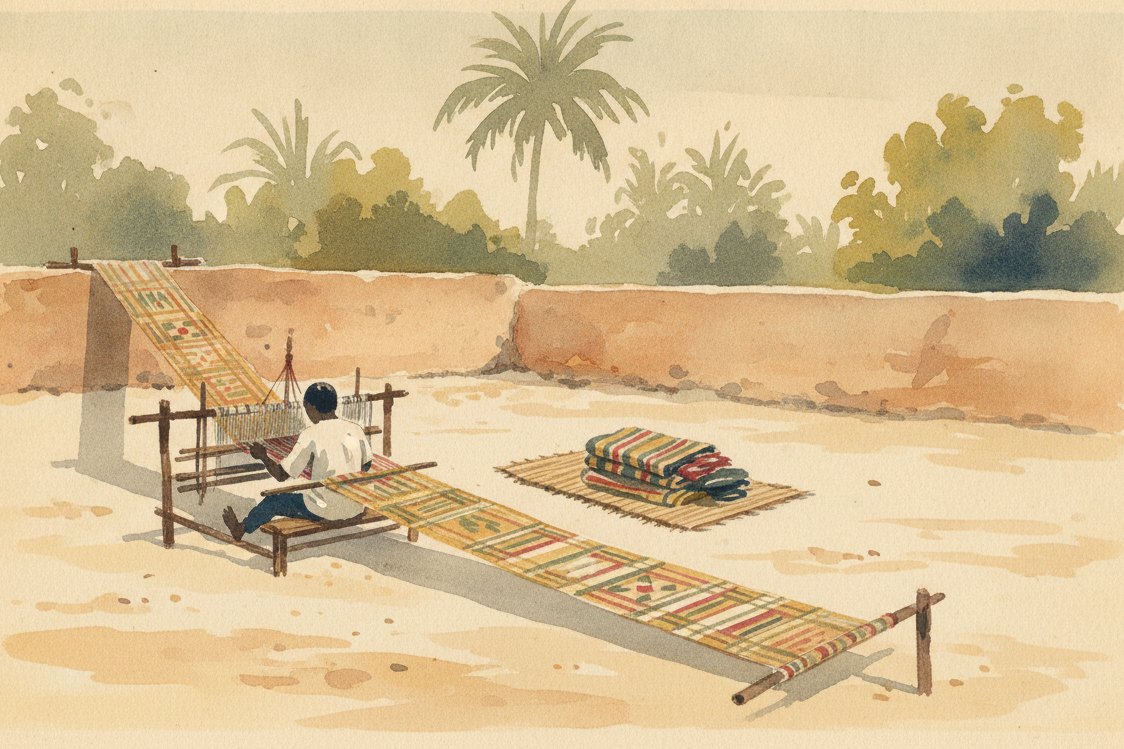
Gold, red, and green blocks crossed by fine warp lines.
- First documented
- 1700s
- Origin
- Bonwire, Ashanti, Ghana
- Fiber
- silk, cotton
- Weave
- strip-woven cloth of color blocks and geometric motifs
- Family
- motifs
Plate No. 163 · fabric
Kente
Kente is the strip-woven cloth of the Akan peoples, above all the Asante of Ghana and the Ewe of Ghana and Togo. It is woven in long narrow bands on a specialized loom, each band a sequence of bright color blocks crossed with geometric motifs, and the finished strips are sewn edge to edge into a bold, large cloth. Every pattern and color carries meaning, gold for status, green for growth, red for sacrifice, and particular designs were once reserved for Asante royalty. From the weaving town of Bonwire it has become a global emblem of African and diasporic heritage, worn on graduation stoles and state occasions alike.
Named for
Most often traced to the Akan kenten, a basket, for the cloth's basket-like interlaced pattern.
Common questions
- What is Kente made of?
- Kente is the strip-woven cloth of the Akan peoples, above all the Asante of Ghana and the Ewe of Ghana and Togo. It is traditionally made of silk or cotton.
- What is Kente named after?
- Most often traced to the Akan kenten, a basket, for the cloth's basket-like interlaced pattern.
Often confused with
Sources & References
- 1.Kente cloth, Wikipedia
- 2.Weaving, Wikipedia
Related specimens
Stay in the loop
From the Almanac
Updates from Fabric Almanac, when there is something worth sharing.