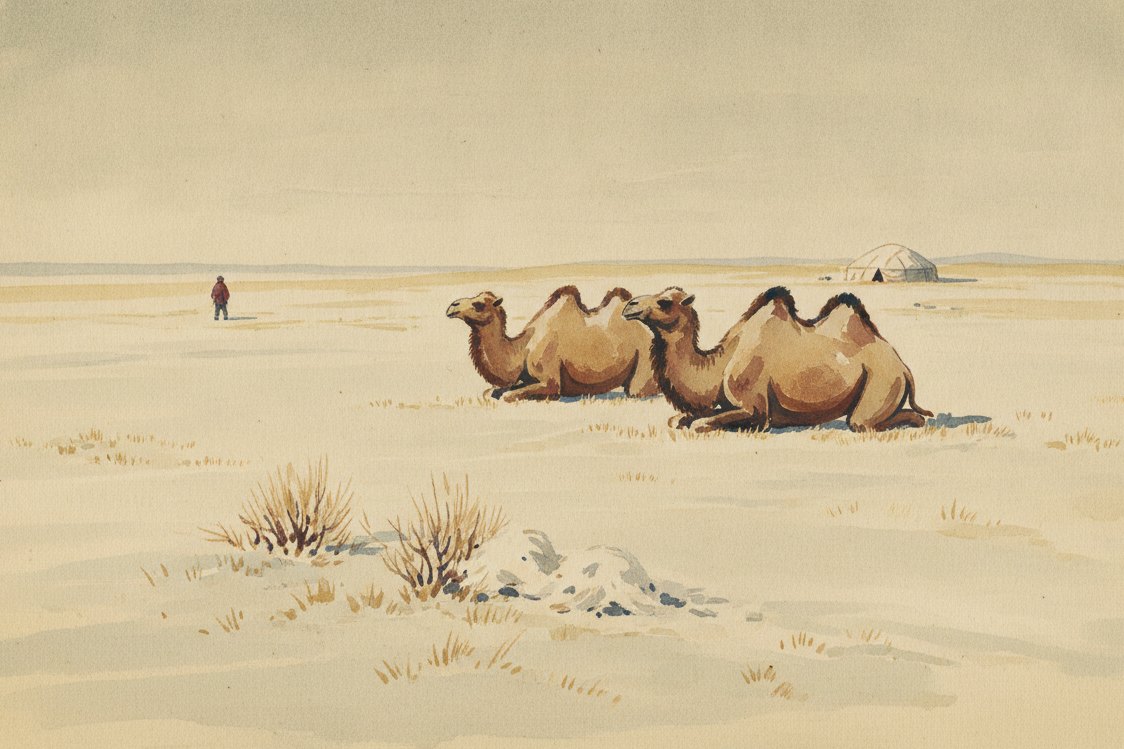
The natural golden tan of the Bactrian camel's down.
- First documented
- Antiquity
- Origin
- Central and East Asia, Mongolia
- Fiber
- camel hair
- Weave
- woven from the down of the Bactrian camel
- Family
- twills
Plate No. 114 · fabric
Camel Hair
Camel hair, as a cloth, is woven from the soft insulating down of the two-humped Bactrian camel, not its coarse outer guard hair. The down is gathered as the animal molts in spring, when it sheds in clumps that are collected and separated, so no shearing is needed. The fiber is warm, light, and a natural golden tan, which gives the camel-hair overcoat and the polo coat their signature color. Carried along the old caravan routes of Central Asia, it became a byword for a soft, costly winter cloth.
Named for
Named directly for the camel; the term properly means the soft undercoat, not the coarse outer guard hair.
Common questions
- What is Camel Hair made of?
- Camel hair, as a cloth, is woven from the soft insulating down of the two-humped Bactrian camel, not its coarse outer guard hair.
- Where does Camel Hair come from?
- Camel Hair comes from Mongolia, Central and East Asia, where it dates to Antiquity.
- What is Camel Hair named after?
- Named directly for the camel; the term properly means the soft undercoat, not the coarse outer guard hair.
Sources & References
- 1.Camel hair, Wikipedia
- 2.Bactrian camel, Wikipedia
Related specimens
Stay in the loop
From the Almanac
Updates from Fabric Almanac, when there is something worth sharing.